# White Paper V2

The Next Generation of DAO

BytomDAO is building an innovative DAO system based on the GenAI technology. If successful, it could considerably change the operating model of current entities and organizations.&#x20;

The new system could transform the basic governance process from "Vote - Execute" to “Create AGI - Decided By AGI“. Our vision is to find a different and better way to AGI and make builders wisdom eternal.

AGI (AGI) is the holy grail for explorers in the field of deep learning.  When AGI succeeds, machines will give everyone incredible new abilities to create new things or solve current problems. When people's abilities are infinitely magnified after using tools, professional skills and physical differences become increasingly insignificant, and the outcomes of personal actions are determined primarily by cognition and methods of thinking.

However, everything always has two sides, the greater the ability, the greater the risk it brings. How to maintain a balance between privacy, interests, and values becomes a test.  OpenAI CEO Sam Altman predicts that there will be "one-person unicorn" in the future, but we believe that it will definitely not be a traditional organizational structure, because there are too many lessons in reality that make us realize the limitations (even OpenAI is also a lesson).So when the AGI comes, we believe that it is necessary to reshape the cooperative relationship between people and between organizations.&#x20;

Below we will discuss the implementation from the aspects of organization, economy, and related technology.


# New Organzation

From the birth of Bitcoin to its growth into a vast market and ecosystem, the real inspiration it provides is its operating model - decentralized collaboration, which makes the system anti-fragile and risk-resistant.

Today, DAO has initially taken shape. It is not restricted by region and ethnicity, leading to the vigorous development of global "digital nomads". Due to some kind of idea or goal, Co-builders can contribute to the organization in any corner of the earth.

We propose a more advanced DAO, a full-process governance form, evolving from **"Vote - Execute"** to **"Create AGI - Decided By AGI".**

We are going to create a new kind of organization that combines the capabilities of AGI and decentralized democracy. DAO is the best form of future AGI entity, and blockchain guarantees the value and rules.

There are four roles in this new organzation.

## Constitution

It represents the basic program and rules of DAO

Traditional DAO constitutions are relatively simple.  Since they are implemented via contract program code that could be automatically executable， they are significantly constrained. More constraints exist in the actual operational process, including:

* **Limited flexibility:** Many scenarios cannot be summarized with IF-Else branch code, limiting the DAO's adaptability in rapidly changing environments.
* **Governance attacks risk:**  Malicious voters may attempt to manipulate rules or outcomes of votes to obtain improper benefits
* **Uncertain regulation**:  There are differences between DAOs and traditional legal systems, so status of constitutions may be unclear, possibly leading to complexities in jurisdiction and legal actions.
* **Information overload:**  Excessively detailed constitutions will make it difficult for voters to understand all the details,  affecting decision-making.
* **Insufficient enforcement**: The effectiveness of a DAO constitution depends on the compliance of its members and the community's ability to enforce it. Without these aspects, even the best-designed constitution may fail to function as intended.
* **Community fork:** Constitutional disputes with the convenience of reconstruction may lead to community fall apart.

In the new organization we propose, governance processes will be changed through the AGI model, which will solve these issues above.

1. AGI can process complex data and extract and generalize key information from it, meaning it can provide data-based decision support for DAO members that cannot be implementment with static code.
2. AGI can design and execute more efficient voting. Humans delegating the voting to the AGI model ensure a fair process.
3. AGI may have exceptionally capable understanding required to meet legal standards in various locations.
4. AGI could provide personalized advice based on the preferences of each DAO member, avoiding issues with comprehension difficulty.
5. AGI will reduce disputes over interpretations and more importantly, building new AGI will be very difficult.
6. End-to-end AGI models allow execution anywhere.

Nowadays, the low cost and high performance of end-to-end models make edge node inference possible.  Mobile side deployment and AI robots have already appeared in the industry. Model training, data and all process can be immutably recorded on blockchain. Biometric identity with controllable privacy has been applied.  Worldcoin gives us a good example which uses the Orb physical device to perform iris recognition to identify the real human.&#x20;

Technically,  "Create AGI - Decided By AGI" is expected to be realized.&#x20;

## Governance Committee

As DAO develops, the constitution also needs to keep up with the times.  The governance committee plays the role of amending the constitution. Committee members ensures proposals and decisions comply with the DAO's long-term interests and values. In a decentralized environment, information and opinions can easily become fragmented, while the governance committee should ensure the flow of information and transparency. When there are disagreements about votes and decisions, the governance committee may intervene to mediate and resolve disputes.&#x20;

Bytomdao governance comittee consists of **5** people responsible for fully implementing the constitutional agenda, including proposal collection, proposal review, proposal voting, supervision of the entire model training and enacting the constitution.

&#x20;Duty of comittee members includes the following key steps:

1. **Proposal Stage:**  Members propose changes . These proposals may concern the top direction of the DAO or amendments to rules.
2. **Discussion & Revision Stage**: Proposals are made public to all members for discussion and deliberation. Members can ask questions, suggest modifications, or express support/opposition to the proposals.
3. **Voting Stage**: After discussion, proposals are put to a vote. Voting rights are distributed based on the proportion of governance tokens held by members.
4. **Updating Stage**: new AGI model will be traing If a proposal receives sufficient support and surpasses a preset threshold, more than 80% of the votes.&#x20;
5. **Recording & Evaluation Stage**: The training process and outcomes are recorded on the blockchain, ensuring transparency and traceability. Subsequently, members can assess the results and propose new initiatives if necessary.

The whole process is cyclical,  for continuous improvement.&#x20;

## Executive Committee

Executive committee is typically a group of individuals to handle the DAO's daily operations and voting processes. The committee may act as representatives of the DAO in negotiations or collaborations with other entities, including partners, other organizations, and the public。&#x20;

The committee have the authority to manage resources of the DAO, like website, contract, AI infrastructure and other assets to keep the DAO functioning.

In BytomDAO, there is no limit to the number of members of the executive committee, but they must be verified by a real natural entity, not web bots.

## Ecosystem Builder

Ecosystem Builders are individuals, teams, or entities that play a crucial role in building, maintaining, and evolving the ecosystem of a DAO. These builders commit to creating and promoting a sustainable, healthy, and evolving decentralized network.&#x20;

Building agents, training models, data mining, and providing AI computing power are all typical tasks for BytomDAO ecosystem builders.


# New Economy

The economic system of the DAO is designed to ensure the self-sustainability of the organization, reasonable incentive mechanisms, and financial transparency. It determines the future value of the entire system.

Several key elements of the DAO economic system:

## DAO Token

The DAO token is often the core of the DAO economic system and can be used as a medium for all transactions and incentives. Tokens can represent voting rights, ownership, or claims to DAO funds.

The governance is usually accomplished through voting, and the right to vote is often associated with the amount of tokens held.

In BytomDAO, there are two types of tokens, $BTM and $BID. $BTM provides a platform for members to participate, invest, vote, and receive financial returns, serving as an essential tool for achieving governance and incentives. It‘s primarily used for:

* **Governance Rights**:  $BTM holders can vote on significant governance matters such as the funds allocationf, projects selection, and rule changes.
* **Financial Stake:** $BTM can also represent a stake in the earnings of the DAO. Holders are entitled to financial returns such as profit buybacks or airdrops.
* **Incentives**: $BTM will be used as rewards for those who contribute to the DAO, such as in operational design, application development, model training, data mining, etc.
* **Fundraising**:  DAO can raise funds by selling $BTM to support project operations and development.

$BID is a verifiable natural entity identity ID, in the form of NFT on chain.  $BID is non-tradable and unique.  Members need to obtain $BID when they want to become executive members or participate in the election to the governance committee.

## Treasury

The DAO treasury serves as the organization's financial reserve and capital account, used for project development and operational expenses. The treasury funds are locked in on-chain smart contracts and cannot be misappropriated by any individual at will.&#x20;

The treasury funds of BytomDAO come from donations from the Bytom Foundation, membership fees, or service fees.  According to the purpose of DAO,  treasury funds will be divided into two parts:

* **Governance Fund**:   It‘s used for expenses of DAO governance. In order to encourage community members to join the governance committee or the executive committee, we will design staking mechanisms. For example,  It is necessary to stake $BTMs to qualify.
* **AGI Fund:**  The fund's capital is to invest in ecological projects and to maintain the  AI infrastructure platform, including  model development and training costs,  and inference service costs. This is the largest portion of the treasury's expenditures, so the risk involved needs to be considered.

As known, DAOs are global and decentralized, but they still must follow local laws and pay taxes. Meanwhile, the issues of AGI development , data privacy and protection are important, all of which need to be treated with great caution.


# New Architecture

In the future, we anticipate that all forms of business can run in the form of DAOs, not just in the crypto industry. The AI model is the most crucial part of these businesses. Therefore, we need to design a decentralized platform that supports model ownership verification and application based on blockchain. This platform can record model information about training, verification, transactions, and applications. All model information recorded on the platform can maintain its immutability and user features, presenting the comprehensive usage scenario of the model.

Firstly, we need to define models on the chain as digital asset, rather than just a collection of files or data. Previously, once a model was released publicly online, it could be freely copied, making it difficult for its owner to claim ownership of its work. Due to the lack of copyright, it was also difficult to profit from copies. In this unrestricted, copyright-free scenario, the value of model cannot be recognized, and model transactions are rarely mentioned. After all, people are unlikely to pay for a product that can be easily copied without proof of ownership.&#x20;

However, model assetization means naming the model so that it can have value properties like an NFT.  Like digital assets on the blockchain, the parties to a transaction can change ownership through smart contracts, completing model ownership transactions. Moreover, the blockchain will permanently record the new owner and verify ownership at any time.

Model ownership includes the entire life cycle of copyright, from the legality of data sources, training parameters, model usage. The legitimate owner of the model will obtain substantial financial returns. Compared to traditional digital assets, we tokenize models in advanced integrated forms, defining new on-chain assets.


# Model Tokenization

There are multiple ways to mark and ensure the rights of a model for various scenarios. Considering the effectiveness and recognizability, embedding digital watermarks into the model is the most feasible and effective method. By embedding watermarks that are difficult to remove, illegal distribution of models can be tracked. This helps to protect intellectual property and prevent model leakage.&#x20;

Watermarks can reveal information about the leaker and other copyright-related details. However, due to the black-box nature of deep learning models, traditional methods cannot embed watermarks into a model without affecting its original functions. So current watermarking methods integrate the embedding process into the training phase by designing specific loss functions, preventing the disruption of the model's original function through the training process. Inspired by traditional parameter-featured methods, we hide the watermark within the model's parameters, which can be decoded through a  decoding process.&#x20;

For generative models, training VAE or GAN module ensures that functionality of the model is not compromised. The advantage of this method is that the watermark is more stable, can hide information within the model, and has anti-attack properties.

The crucial parts in building such a platform include model tokenization, model verfication, model transaction, and transaction log recording. The entire process is divided into the following steps:

1. Watermark embedding and extraction

Unlike non-blockchain architectures,  feature watermark generation requires users to manually select specific features.  Because of the lack of control or simply selecting strategies, It may result in conflicts due to close Hamming distances between watermarks chosen by different users, making them difficult to distinguish. Therefore, utilizing smart contracts on blockchain for negotiating watermark is a better choice. &#x20;

<figure><img src="https://169284680-files.gitbook.io/~/files/v0/b/gitbook-x-prod.appspot.com/o/spaces%2FmBYtPVROAXUssGYR1y6h%2Fuploads%2F6vK2FeVYLXNYQHhzCi9p%2Fimage.png?alt=media&amp;token=22a7dc2d-f9f5-41f0-bbc6-6f84921fa00d" alt=""><figcaption></figcaption></figure>

Users obtain a decoding matrix ***X*** and a watermark matrix ***K*** through the negotiation contract. NNegotiation is based on the keys allocated by smart contracts. It can achieve this goal by optimizing the loss function by adding a regularization term into the objective functions. In this design, we embed the watermark ***K*** into the elements of ***XW***. The watermark embedding process fits the watermark into the model by training parameters. The blockchain records the mapping of the model along with its unique watermark. With the support of IPFS or other decentralized storage technologies, the model can be stored and published on-chain. Anyone can use the on-chain contract to know true owner of the model by invoking the query function.

<figure><img src="https://169284680-files.gitbook.io/~/files/v0/b/gitbook-x-prod.appspot.com/o/spaces%2FmBYtPVROAXUssGYR1y6h%2Fuploads%2FB8U2jncrlDo6K1TpPPKx%2Fimage.png?alt=media&amp;token=61c2c840-86f3-44c8-8e6b-ab0132a97482" alt=""><figcaption></figcaption></figure>

When a user claims ownership of a model, we need to confirm it through watermark extraction. Smart contracts will search for the model token owned by the user and verify through decentralized validation mechanisms whether the watermark can be detected in the model.   We multiply the decode matrix ***X*** with the model parameters ***W*** to extract the watermark and get model information by adding step function **S**.  After information comparison with watermark ***K*****,**  it will be clear whether the two models are the sam&#x65;***.***

2. On-chain Processing

On the blockchain, smart contracts store the mapping between user addresses and watermarks with designed data structures to  tokenize models. The core structure of the contract comprises three crucial components:  the watermark negotiation module, metadata for model training process and the record of model ownership rights holders.&#x20;

<figure><img src="https://169284680-files.gitbook.io/~/files/v0/b/gitbook-x-prod.appspot.com/o/spaces%2FmBYtPVROAXUssGYR1y6h%2Fuploads%2Fg44AG59DrlHzEQ2p4DGI%2Fimage.png?alt=media&amp;token=0f12b214-52fe-423d-974d-2784e4866fc3" alt=""><figcaption></figcaption></figure>

Once the blockchain completes the watermark negotiation process with users, the mapping between the user and the watermark is established. When a user claims ownership of a model, the smart contract searches this data structure using the user's address and the mapping of ***X*** and ***K*** to retrieve the model token owned by the user, then verifies through decentralized validation mechanisms whether the watermark can be detected in the model. If a transaction is required, updating the contract data structure records the latest holder information along with the transaction timestamp, completing on-chain data updates.&#x20;

Additionally, it's essential to note that on-chain watermark validation requires a certain fault tolerance, it cannot be 100% accurate. Assuming we want to insert an **n**-bit watermark and the tolerance for the error rate is **r,** it means if the number of different bits between the original watermark and the extracted watermark is less than **rn**, we still confirm the copyright. The Hamming code indicates the count of different bits between two bit streams when designing an error-correcting code. In this scenario, the Hamming distance between the original watermark of different users must meet the minimum distance of 2**rn**. Otherwise, due to the possibility of generating the same decoding result from two watermarks within the fault tolerance range, the validation process will be confused, leading to ownership conflicts.


# CryptoGPT

Although many large language models (LLMs) like ChatGPT perform well on natural language processing tasks, the unique data feature in the crypto industry pose significant challenges for these models. As a result, there is an urgent need to develop a LLM  designed for crypto with strong cross-dataset/task generalization capabilities. To address this issue, we propose the CryptoInstruct dataset, which is the first dataset of its kind tailored for the crypto industry, containing 3 million instruction dataset. CryptoInstruct expands data scale and task diversity by constructing atomic tasks related to fundamental data types in the crypto industry, such as project information and industry knowledge. These atomic tasks, known as Chain-of-Task tasks, represent intermediate tasks implicitly involved in solving the final task.

By fine-tuning the base model Llama3 with  CryptoInstruct dataset, we have developed CryptoGPT and trained it at different parameter scales. Benefiting from the fundamental semantic understanding obtained from chain-of-task tasks, CryptoGPT demonstrates outstanding zero-shot generalization capabilities. Extensive experiments and human evaluations indicate that CryptoGPT outperforms ChatGPT in cross-dataset/task generalization on tasks related to the crypto industry.

The data is sourced from publicly available data and historical information obtained through public web crawlers, spanning from the birth of Bitcoin in 2009 to now in 2024, providing a comprehensive record of the entire history of the crypto industry.

CryptoGPT can be used for decision making, serving as a helpful assistant for general users and a powerful tool for professionals in their work.

<table data-header-hidden><thead><tr><th width="273">Field</th><th>Role</th><th>Goal</th></tr></thead><tbody><tr><td>Investment / Speculation</td><td>Investor (Primary market）</td><td>Investment institutions or qualified investors seek to find promising projects for early-stage investment. They are interested in project team members, roadmap, development progress, fundraising, and other factors, aiming to identify projects with high potential.</td></tr><tr><td></td><td>Trader/Speculator (Secondary market)</td><td>To be primarily focus on the fluctuations of the secondary market. They are in favor of market analysis, technical analysis, and market news.</td></tr><tr><td></td><td>Arbitrageurs</td><td>To engage in on-chain and off-chain arbitrage and mainly care about price differences and arbitrage opportunities.</td></tr><tr><td></td><td>Airdrop hunter</td><td>To find potential airdrop opportunities for new projects, and earn the reward at the lowest cost</td></tr><tr><td></td><td>Miner</td><td>To discover new mining opportunities, reduce mining costs, and get information about mining rigs</td></tr><tr><td>Crypto Project</td><td>Management team</td><td>To be aware of potential  market, new innovations, breakthroughs, and the competitive landscape</td></tr><tr><td></td><td>Operation team</td><td>To make project operation planns and new strategies that can attract more users</td></tr><tr><td></td><td>Media editor</td><td> To write, polish, and accumulate information to create popular articles</td></tr><tr><td></td><td>Exchange</td><td>To discover protential projects listing token and Identify scam projects</td></tr><tr><td>Web3 Developer</td><td>Contract Developer</td><td>To develop DApp based on smart contract</td></tr><tr><td></td><td>Web3 security auditor </td><td>To analysis of smart contract vulnerabilities and project vulnerabilities.</td></tr><tr><td>NFT</td><td>NFT issuer/ Crypto artist</td><td>To create NFT issuance  and learn how to attract more players</td></tr><tr><td></td><td>NFT player</td><td>To find new potential NFTs and make profit</td></tr><tr><td>GameFI / Metaverse</td><td>Crypto gaming guild</td><td>To make profit by playing games and pursue high ROI</td></tr><tr><td></td><td>Crypto game player</td><td>To have fun</td></tr><tr><td>Regulation / Policy</td><td>Lawyer/ Compliance team</td><td>To be informed of crypto industry regulations enacted by various countries, and compliance measures for project</td></tr><tr><td>Other</td><td>KOL/KOC/Influencer</td><td>To provide followers with practical insights and reviews on web3 project.</td></tr></tbody></table>


# DAgent

Tradiitional DApp stands for Decentralized Application. It's an application that runs on a decentralized network, typically a blockchain network。DApps utilize smart contracts, which are self-executing code deployed on chain.\
Nodes of blockchain automate and enforce the rules of the application without third-party intermediaries. It also comes with certain limitations: &#x20;

1. Blockchain networks on which DApps are often built, suffer from scalability issues. As the number of users and transactions increases, the network may become congested, leading to slower transaction processing times and higher fees. User experience of DApps can sometimes have a steeper learning curve and less intuitive user interfaces compared to traditional applications. This can be a barrier to massive adoption for mainstream people who are not familiar with blockchain technology.&#x20;
2. Storing data on a blockchain can be expensive. This can limit the scalability and cost-effectiveness of DApps, particularly for applications with high data storage needs.
3. Each transaction on a blockchain incurs a cost, typically in the form of gas fees or transaction fees. For DApps that require frequent transactions, these costs can add up and make the application less economically viable for users.

We introduce DAgent,  the DApp 2.0, which built on LLM technology, to tackle the challenges of DApps. By storing memory vector on-chain and integrating off-chain plugins, we greatly enhance application scalability. There are advantages:&#x20;

1. I**nnovative Interaction**: DAgent employs an end-to-end approach where users accomplish tasks through chat, requiring minimal specialized knowledge.
2. **Cost Reduction**: The cost of model execution shifts from on-chain to off-chain, converting Gas costs into GPU runtime.  Memory vectors are stored on-chain, ensuring the verifiability and trustworthiness of the entire process.
3. **Information Processing Capability**: DAgent can receive off-chain information in real time with personalized customization plugins .
4. **Real Smart Applications**: Lowering the development threshold through the Chain-of-Thought approach enables the creation of diverse applications.

<figure><img src="https://169284680-files.gitbook.io/~/files/v0/b/gitbook-x-prod.appspot.com/o/spaces%2FmBYtPVROAXUssGYR1y6h%2Fuploads%2Flhg2padicTeq8SFDYiGi%2Fimage.png?alt=media&amp;token=a257d2fa-c91f-4a33-ab62-347fa51683ac" alt=""><figcaption></figcaption></figure>

DAgent can enrich on-chain applications, potentially giving rise to a new ecosystem spanning across models.


# White Paper V1

Make Crypto Wisdom Eternal

Fifteen years ago, the birth of Bitcoin marked the beginning of an era of decentralized assets.

This period has seen significant developments in the field of decentralized asset applications, giving rise to a groundbreaking concept: Web3.

Distinct from the traditional internet, Web3 embodies a decentralized network framework, representing the forefront of internet innovation. While theoretically appealing, the practical adoption of Web3 is still in its early stages, hindered by numerous challenges.

These include technical intricacies, user adoption barriers, legal complexities, and integration issues with existing network infrastructures. So its path to massive adoption is far from complete.

Meanwhile, generative artificial intelligence (GenAI) is evolving at an extraordinary pace. Innovative applications, such as ChatGPT, have seamlessly integrated into various facets of daily life, ranging from electronic devices to autonomous vehicles, and from healthcare diagnostics to financial services.

The growing impact of GenAI is driven by substantial investments and an influx of talent, propelling its development forward.

These advancements are narrowing the gap between human and machine interaction, fostering new market opportunities.

We believe that GenAI will not only be a key factor in the widespread adoption of Web3 but also offer solutions to the privacy and data security issues. This synergy suggests a mutually beneficial relationship between GenAI and Web3.

So Bytom, dedicated to asset tokenization, will focus more on data asset. We propose a new form of assets, a new way of interaction, and a new way of thinking. Our belief is twofold: AI innovation holds the key to the massive adoption of Web3, and conversely, Web3 innovation can address prevailing challenges in AI development.

In light of these insights, we are initiating the third phase of Bytom — the Bytom DAO. As a non-profit organization, Bytom DAO will concentrate on content applications and the organizational structure of digital assets within the Web3 ecosystem.

[Download the PDF](https://cdn.bytom.io/res/bytom3.0/Bytom%20DAO%20WhitePapre.pdf)&#x20;

## &#x20;<a href="#id-38cd" id="id-38cd"></a>


# Our Vision

We present a visionary framework composed of two pivotal aspects:

## **The Synthesis of AGI and Web3**

To meld the inherent decentralization of Web3 with the advanced GenAI.

## **Perpetuate the Wisdom of Crypto**

This can be accomplished by implementing advanced large language models (LLMs). To realize our vision, we’ve identified three primary objectives:

**(1) Democratizing Access to Cryptocurrency**

The first objective aims to lower entry barriers for newcomers in the crypto world by simplifying user interactions. Our strategy encompasses both educational and technological initiatives. Educational AI-driven tools will be deployed to help new users grasp the fundamentals of Web3 and its operational mechanisms. These will leverage AI to streamline intricate processes involved in trading, investing, and asset management, making them more accessible and user-friendly.

**(2) Enhancing Security and Combating Fraud**

Security is of utmost importance in the decentralized world. Given the widespread hacking incidents and the risks to digital assets, we’ll employ AI to proactively identify and mitigate high-risk fraudulent activities. This objective also involves strengthening the security of smart contracts. By enhancing code and system resilience against various attacks, we’ll establish a more secure and trustworthy environment for cryptocurrency transactions.

**(3) Turning Data into Tradeable Assets with Defined Rights**

As GenAI grows, issues like data rights and personal privacy become increasingly crucial. The challenge is evident with frequent leaks and infringements. Our aim is to use blockchain to confirm and trade data rights, empowering users with control over their data, including the option to monetize while safeguarding privacy. Blockchain’s immutability and smart contracts ensure effective copyright management, preventing infringement and piracy.


# The New Tokenomics

Embracing the visionary future, Bytom is strategically shifting to a new economic model and governance mechanism. The previous public chain doesn’t align well with the evolving ecosystem. Instead, our redesigned economic model and governance structure are crafted to ensure our tokenomics directly correlate with strategic goals.

**1. Transition to Bytom DAO**

The Bytom Blockchain is evolving into Bytom DAO, marking a significant transition from the traditional public chain token model to a decentralized application (DApp) token model.

**2. Fixed Supply of Bytom DAO Tokens**

There will be no further issuance of Bytom DAO Tokens (BTM).

**3. Strategic Usage of BTM**

The existing BTM will be used to support ecosystem development and facilitate application payments.

**4. Shift to DAO Governance**

Bytom is adopting a decentralized autonomous organization (DAO) model, putting the community at the center. This empowers them with control over proposals, decisions, and fund management.

To boost our strategic shift, the Bytom Foundation is initiating a comprehensive community DAO-ization process. Anchored in community-driven governance, the aim is to establish a sustainable ecosystem. The founding team will transfer all rights to a Temporary Autonomous Committee(TAC), gradually devolving control to the community. This includes stewardship of the foundation, project codes, documentation, community resources, and operational accounts.

All tokens (about 20%) held by the Bytom Foundation will be allocated to the DAO treasury for community management. As a non-profit organization, all investments and revenues are funneled into DAO treasury, which will also serve as the funding source for community operational expenses. While the founding team will cease to lead the daily operations, we will continue to support community initiatives and contribute to our new vision.

This transformation is anticipated to attract a diverse and international talent pool. With a focus on research and regional compliance policies, we envision the emergence of a professional public welfare foundation dedicated to advancing technology in the Web3 and AI industry.


# The New Roadmap

The following key milestones are outlined:

**1. Suspension of Bytom Blockchain Applications and Token Migration**

To facilitate this transition, we will suspend all operational applications on the Bytom Blockchain and conduct a comprehensive token migration.

**2. Shutdown of Bytom Blockchain and Node Withdrawal**

Subsequently, the Bytom Blockchain will cease operations and provide a seamless withdrawal process for staking nodes.

**3. Transition to TAC Management**

This TAC will take over all daily management and authority of Bytom Foundation and accomplish a complete transition to a DAO model over the next 6 months, effectively handing over the control right of the project to the community.

**4. Launch of DAO Governance Mechanism**

The TAC will be responsible for unveiling the DAO governance mechanism and initiating the community voting process. Upon approval through voting, the mechanism will be officially implemented.

**5. Implementation of DAO Governance and AI Ecosystem Fund**

Once the DAO governance mechanism is operational, the AI ecosystem fund will simultaneously be launched, marking the beginning of a new chapter in the Bytom DAO era.


# The Decentralized Future

The ongoing evolution of GenAI and Web3 is a dynamic journey, reshaping our societal structure and resource allocation. In this changing landscape, Bytom DAO aims to be a pivotal bridge, engaging in progressive research and infrastructure development. We seek to enhance collaboration with globally recognized projects, seamlessly integrating BTM into their systems. This expansion of BTM utilities is expected to bring about a deflationary phase, boosting its intrinsic value for holders.

No matter how long the journey, we’ll reach our destination by staying the course. Despite the difficulty of the task, we’ll get it done through continuous effort.


# Governance

We are delighted to announce the formal introduction of governance mechanisms into BytomDAO's operations, enabling our community members to engage directly in decision-making processes through voting.

Here are some things you need to know.

### **What is Governance ?**

Governance refers to controlling the transfer of assets within a DAO organization or changing the rules of organizational operation by initiating proposals. Any changes require community voting permission to proceed, and no individual or organization has absolute leadership.

Common DAO governance methods are divided into on-chain governance and off-chain governance. Off-chain governance typically uses tools like Snapshot for voting, and then the DAO's managers act based on the voting results. This governance method is more like a process of collecting opinions, where the final actions still need to be managed by specific people, resulting in a higher degree of centralization.&#x20;

<figure><img src="https://169284680-files.gitbook.io/~/files/v0/b/gitbook-x-prod.appspot.com/o/spaces%2FmBYtPVROAXUssGYR1y6h%2Fuploads%2FD9SsMDsvMgkKYivc41Kq%2Fimage.png?alt=media&amp;token=742b8503-8290-47b5-8eb3-60e65c5aedd9" alt=""><figcaption><p>Offchain voting requires social trust.</p></figcaption></figure>

Meanwhile, BytomDAO is currently implementing on-chain governance based on Tally. It use smart contracts to propose, vote on and execute proposals. That makes DAO operations automated, trustless, and more decentralized.

A complete governance lifecycle includes the stages of Create a Proposal, Voting on Proposals, Queuing and Executing Proposals. If a proposal does not pass, there will not be a final execution step.

All BTM holders can participate in the governance of the DAO, with each BTM held being exchangeable for one voting right. This means the more BTM you own, the higher your voting power and the greater your say.

### What is Treasury ?

The Treasury contains assets owned by the BytomDAO organization that can be utilized.&#x20;

The primary asset in the Treasury is currently BTM, with an initial amount of 420,000,000, later receiving donations of 17,609,027.843, bringing the current total to 437,609,027.843. After BTM is burned, the initial total circulating supply is 1,640,515,591.91, and there will be no further issuance, making BTM a deflationary token.&#x20;

Furthermore, after BytomDAO earns other assets, it will vote to decide on repurchasing BTM, further reducing its circulation in the market.

### What is Proposal ?

Creating a Proposal is the process of initiating a proposal to gain approval from organization members and to transfer assets completely.&#x20;

BytomDAO uses the Tally platform to manage the complete lifecycle of Proposals, with all actions executed on-chain, ensuring full decentralization. Once a Proposal is passed, it will be automatically executed and not controlled by any party.

The status of a Proposal includes six stages: Draft created, Published onchain, Voting period started, Voting period ended, Proposal queued, Execute Proposal. A complete and successful execution of a Proposal requires meeting certain conditions, with key parameters as follows:

| Parameters             | Value      |
| ---------------------- | ---------- |
| **Proposal threshold** | 2 million  |
| **Quorum needed**      | 10 million |
| **Proposal delay**     | 5 days     |
| **Voting period**      | 7 days     |

This is a detailed interpretation of the above parameters.

***Proposal Threshold**:* This is the minimum number of governance tokens that a proposer must hold to initiate a proposal. You can only submit a proposal if you hold more governance tokens than this threshold.

***Quorum Needed***: A proposal can only pass if it receives support from a number of votes that exceeds this threshold.

***Proposal Delay***: This term represents the waiting time from when a proposal is made until voting begins.

***Voting Period***: This indicates the duration available for voting on each proposal. Once this period expires, no further votes can be cast.


# Prerequisite conditions

Holders of BTM have governance rights within BytomDAO, allowing them to vote on proposals or delegate their voting rights to a third party.&#x20;

Users holding more than the number of proposal threshold have the right to initiate proposals.

The prerequisite for participating in all governance activities is having BTM Token in your wallet. If you do not have BTM, you can obtain it from the exchanges.


# Obtaining voting rights

The BTM you hold cannot be directly used for voting. Before voting, you need to exchange BTM for voting rights at a 1:1 ratio. You can exchange BTM for votes at any time, and you can also convert votes back to BTM at any time. This operation will not cost your BTM.

First, you need to go to the BytomDAO's website,  launch the governance application, and scroll to the "Get Votes" feature module.

<figure><img src="https://169284680-files.gitbook.io/~/files/v0/b/gitbook-x-prod.appspot.com/o/spaces%2FmBYtPVROAXUssGYR1y6h%2Fuploads%2FPzcNSQ71R8tSj8vKWCpn%2Fimage.png?alt=media&amp;token=64eacaa8-88d2-4e05-abf9-d5e0c95b5fa9" alt=""><figcaption></figcaption></figure>

Here, you will see the current voting shares you possess. You can click "Get more" to exchange your BTM for shares used for voting.Of course, consistent with other procedures, you first need to approve the use of your BTM shares.

<figure><img src="https://169284680-files.gitbook.io/~/files/v0/b/gitbook-x-prod.appspot.com/o/spaces%2FmBYtPVROAXUssGYR1y6h%2Fuploads%2FrbDL2oA6qFNK1ssjnOhl%2Fimage.png?alt=media&amp;token=03b910de-3b3d-49ce-af89-15ab29a4ab21" alt="" width="349"><figcaption></figcaption></figure>

Similarly, you can click "Exchange for BTM" to convert your votes back to BTM.

<figure><img src="https://169284680-files.gitbook.io/~/files/v0/b/gitbook-x-prod.appspot.com/o/spaces%2FmBYtPVROAXUssGYR1y6h%2Fuploads%2FkiVMhPOwAGPp8qknsOrB%2Fimage.png?alt=media&amp;token=b7d4ec05-44b1-4be2-8620-448122ca55ae" alt="" width="344"><figcaption></figcaption></figure>

Once you have obtained voting rights, you can participate in the governance of BytomDAO.


# Vote

The Proposals module will display all proposal histories and ongoing proposals. Here, you can click on a proposal to enter the voting process.

Note that each vote has a deadline. Please make sure to vote before the deadline.

<figure><img src="https://169284680-files.gitbook.io/~/files/v0/b/gitbook-x-prod.appspot.com/o/spaces%2FmBYtPVROAXUssGYR1y6h%2Fuploads%2FfrTn70kW1jd4CSuzw5GV%2Fimage.png?alt=media&amp;token=93a361c3-c8e4-483c-aa71-c02c34dbc431" alt=""><figcaption></figcaption></figure>

Voting will be conducted on the Tally platform. Click "Vote on chain" to enter the voting process.

<figure><img src="https://169284680-files.gitbook.io/~/files/v0/b/gitbook-x-prod.appspot.com/o/spaces%2FmBYtPVROAXUssGYR1y6h%2Fuploads%2FXqnVg49Cluak4n7Oa66N%2Fimage.png?alt=media&amp;token=44cd73e7-8747-4abe-9239-55ca9a55abd4" alt=""><figcaption></figcaption></figure>

Choose whether you support or oppose the proposal. Of course, you also have the option to abstain.

<figure><img src="https://169284680-files.gitbook.io/~/files/v0/b/gitbook-x-prod.appspot.com/o/spaces%2FmBYtPVROAXUssGYR1y6h%2Fuploads%2FbUp9W3EsOws1KUWnTEnK%2Fimage.png?alt=media&amp;token=d379ed1b-bcf8-4a94-afef-eed32587b7d4" alt="" width="343"><figcaption></figcaption></figure>

When the number of votes in support reaches the limit and exceeds the number of votes against, the proposal will be executed.

You can view the real-time voting status and the number of votes on the Tally platform.

<figure><img src="https://169284680-files.gitbook.io/~/files/v0/b/gitbook-x-prod.appspot.com/o/spaces%2FmBYtPVROAXUssGYR1y6h%2Fuploads%2FxFhcPqBj34XVTsCY7fjP%2Fimage.png?alt=media&amp;token=b119f17a-cae9-41ed-b498-6f1d11293fc2" alt="" width="270"><figcaption></figcaption></figure>

<figure><img src="https://169284680-files.gitbook.io/~/files/v0/b/gitbook-x-prod.appspot.com/o/spaces%2FmBYtPVROAXUssGYR1y6h%2Fuploads%2FtT0lr2yF2FYxpFRfGMRi%2Fimage.png?alt=media&amp;token=8ce4609a-2774-46f0-bd66-5010da542b7f" alt="" width="248"><figcaption></figcaption></figure>


# Submit Proposal

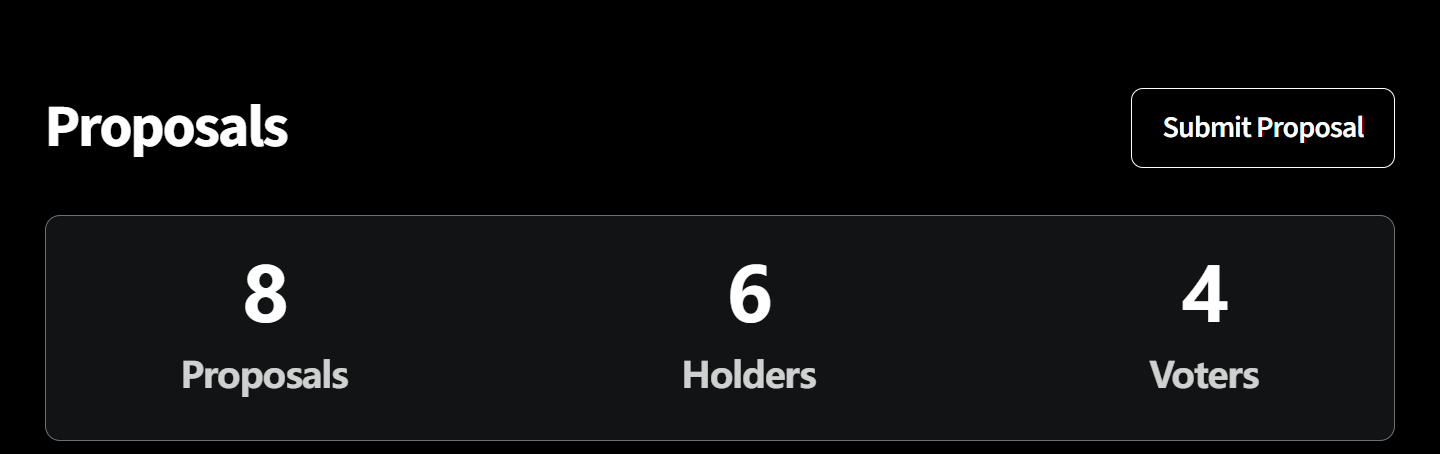
If your BTM holdings exceed the threshold, you have the right to initiate proposals using the "Submit Proposal" function on the official website.

<figure><img src="https://169284680-files.gitbook.io/~/files/v0/b/gitbook-x-prod.appspot.com/o/spaces%2FmBYtPVROAXUssGYR1y6h%2Fuploads%2F30GQKbgcNtydbzocfx7b%2Fimage.png?alt=media&amp;token=a4e4e8bd-0f36-437d-ba99-d96baac180e4" alt=""><figcaption></figcaption></figure>

Next, you can create a proposal on the Tally platform.

A detailed Title and Description will help community members better understand your idea. Please describe the content of the proposal you wish to initiate as specifically as possible.

<figure><img src="https://169284680-files.gitbook.io/~/files/v0/b/gitbook-x-prod.appspot.com/o/spaces%2FmBYtPVROAXUssGYR1y6h%2Fuploads%2FZ9gxZBfz7SZEeVXdJ4VM%2Fimage.png?alt=media&amp;token=0ed739d2-0d18-42d1-9712-63e381935bfb" alt=""><figcaption></figcaption></figure>

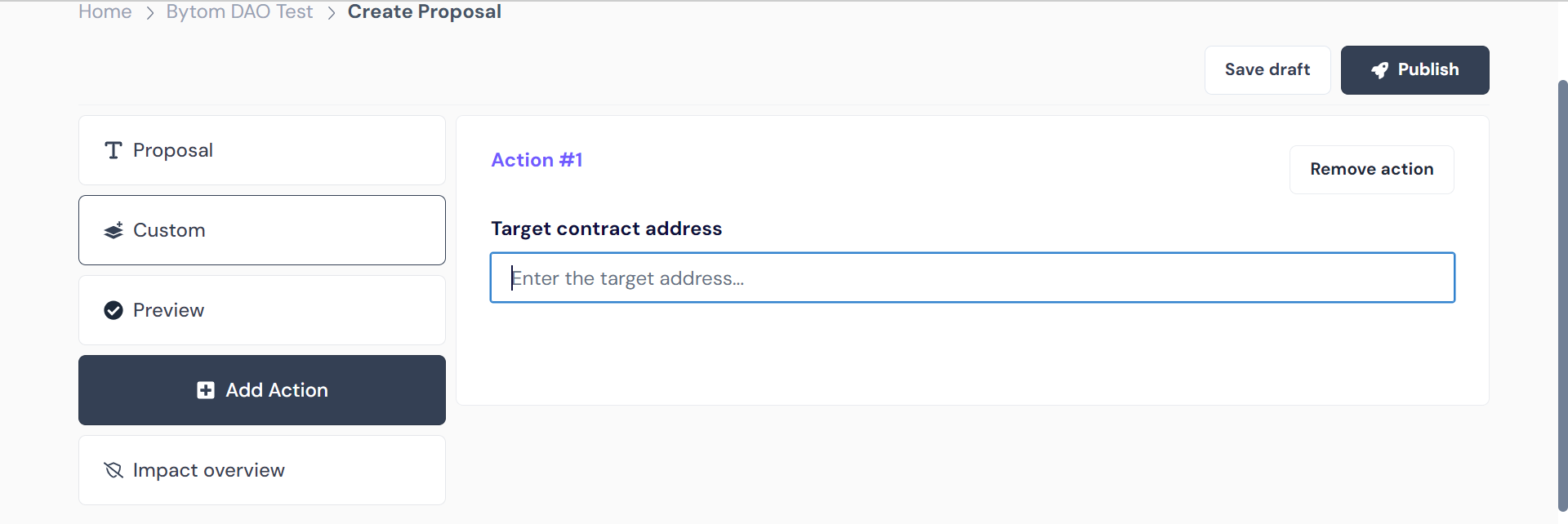
If your proposal involves adjusting governance parameters or using treasury assets, you need to add an "Action." Here, we recommend using the Custom action feature.

<figure><img src="https://169284680-files.gitbook.io/~/files/v0/b/gitbook-x-prod.appspot.com/o/spaces%2FmBYtPVROAXUssGYR1y6h%2Fuploads%2FaH14HlnyRunIWzsd9ERx%2Fimage.png?alt=media&amp;token=9fff41e9-b29b-48a1-92c0-1284ac8cdbf2" alt=""><figcaption></figcaption></figure>

You need to fill in the completed contract address and select the method to use. After setting it up, choose "Publish."

<figure><img src="https://169284680-files.gitbook.io/~/files/v0/b/gitbook-x-prod.appspot.com/o/spaces%2FmBYtPVROAXUssGYR1y6h%2Fuploads%2FylNaOHIQh1rzgiYfzf1B%2Fimage.png?alt=media&amp;token=093c5183-82af-410f-93e2-b06af12f8603" alt=""><figcaption></figcaption></figure>

Next, you just need to wait for the proposal to be published on the chain. After that, community members can vote on this proposal.


# Queuing and Executing Proposals

*Once voting ends, a proposal is not done. If a proposal passed, there are still more steps to take before it’s executed. A successful Governor proposal still needs to be **queued**—if the DAO uses a Timelock—and then **executed**.*

Once a proposal passes, you can queue and execute it from the same place you voted.

Only after all steps are completed will the proposal be truly executed, especially for proposals that involve contract calls.<br>